
By Dr. Michael J. Keller, Director of Social Emotional Support, Laguna Beach Unified School District, Challenge Success Board of Directors
How might artificial intelligence (AI) be used to strengthen human connections?
At Laguna Beach Unified School District, a learner-centered PreK-12 district serving over 2,300 students in Southern California, this question has guided our philosophy on how to both explore the AI landscape in schools and simultaneously strengthen our human capital. This post explores how strengthening collective teacher efficacy (CTE) through relational adult learning, intentionally supported by AI tools, has led to measurable gains in student engagement and belonging. We argue that when AI is used to amplify storytelling, reflection, and shared purpose, it becomes not a technological distraction but a catalyst for human connection.
Student Belonging Drives Full Engagement
Since 2018, our partnership with Challenge Success has focused on three interdependent conditions: well-being, engagement, and belonging. Across the SPACE framework, we have committed to improving the student learning experience by:
- Adjusted secondary start times to better align with adolescent sleep research and promote student well-being.
- Implemented modified block scheduling to create space for deeper learning and sustained engagement.
- Expanded tutorial and advisory structures to provide targeted enrichment, intervention, and relationship-centered support.
- Redesigned units of instruction (280 units to date) to increase relevance, elevate authentic assessment practices, and amplify student voice and agency.
- Strengthened our multi-tiered systems of care with an emphasis on prevention education, strong teacher–student relationships, and a comprehensive continuum of support.
- Deepened family and community engagement through book studies and responsive parent education events focused on priority topics such as healthy technology use, youth mental health, play, downtime, and family time (PDF), and strengthening home–school partnerships.
Through this work, an important theme emerged: student engagement is a direct outcome of the quality of teacher-to-teacher and teacher-to-student relationships.
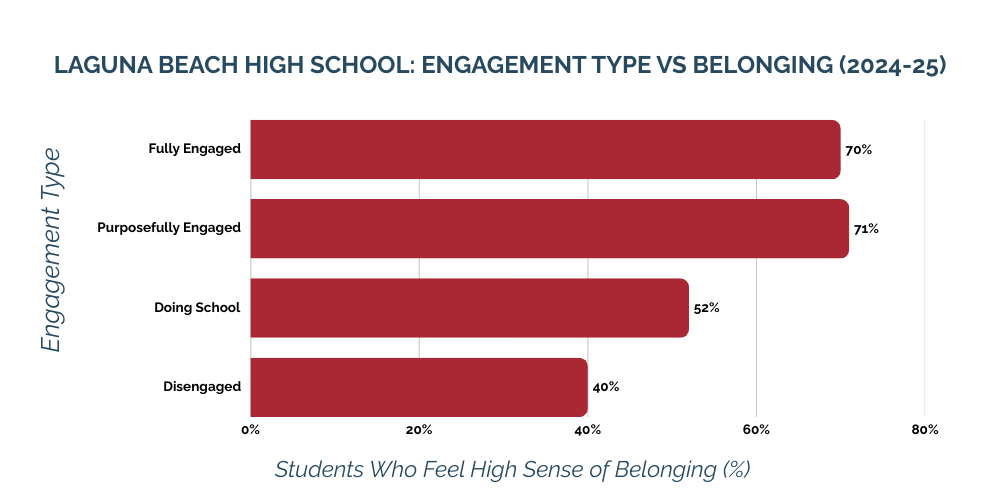

Our Challenge Success student survey data revealed a compelling pattern. At Laguna Beach High School, the percentage of students reporting they are “fully engaged” (behaviorally, affectively, and cognitively) doubled from 12 percent in 2019 to 24 percent in 2025. Most notably, students reporting the highest levels of engagement also reported the strongest sense of school belonging. We believe that the students’ sense of belonging was directly related to our purposeful effort to strengthen collaborative relationships among colleagues and to open classrooms and departments to planning across the curriculum.
Related Resource: Learn about the Challenge Success School Partnership for K-12 Schools
Grounding AI in Collective Teacher Efficacy
To enhance connections among adults, we look to Collective Teacher Efficacy (CTE) as a factor to strive to improve in our schools. According to John Hattie’s (2018) research, CTE has an effect size of +1.57, placing it among the most powerful influences on student learning. Schools where educators believe they can collectively make a difference are far more likely to do so.
However, collective efficacy does not emerge from isolated expertise; it grows from trust, shared vulnerability, and mutual problem-solving. This insight shaped our adult learning work with AI. Designed alongside former Chief Technology Officer Mike Morrison, our professional development explored AI tools while intentionally strengthening relational trust. At the Challenge Success Annual Conference in 2025, Mike Morrison and I presented a session titled “AI & Belonging: How Human Connection and Technology Can Build Trust, Creativity, and Collective Efficacy.”
We drew on interpersonal closeness research from UC Berkeley’s Greater Good Science Center, using their framework of progressively deeper self-disclosure to build trust in developmentally appropriate ways.
While the public conversation around AI often centers on academic dishonesty or workforce disruption, concerns that require careful attention, we believed AI could actively enhance CTE if used to promote reflection, storytelling, and shared understanding.
Related Resource: Read our recent blog post, “When AI Replaces the Friend Who ‘Helped’ With Chemistry Homework”
Strengthening Human Connection with AI
Using the Berkeley closeness framework as our guide, we structured our adult learning to enhance CTE around three distinct moves:
- Start in the Past (Shared Nostalgia): Participants used AI image-generation tools (e.g., Google Gemini, ChatGPT) to visualize meaningful autobiographical memories. From childhood summers to influential mentors, staff iterated their AI prompts to capture the qualitative feel of these moments. Sharing these images prompted storytelling, laughter, and connection.

- Share the Present (The Perfect Day): Using the AI music creation tool Suno, participants composed songs describing their perfect day. Whether it was a reggae-inspired family beach trip or a pulsing dance track about a night out, sharing these lyrical narratives beautifully revealed shared personal values.
- Dream About the Future (Aspirations): Finally, participants used Google’s NotebookLM to generate podcast-style audio reflections of their professional and personal aspirations. Narrating long-held dreams and hearing them reflected back sparked awe, imagination, and clarity.
From Adult Collective Teacher Efficacy to Student Engagement
This work ultimately transcends adult development, as our students experience what we model. We now use NotebookLM with students, integrating their transcripts, resumes, and teacher endorsements to create reflective audio summaries. Students hear their own stories synthesized in ways that highlight their value, purpose, and impact.
AI tools, used responsibly, can personalize learning. Students can role-play conversations, visualize scientific concepts, or explore topics in their primary language. But the AI tool is never the end goal. The goal is connection. We must confront the risks AI presents regarding safety, fairness, and privacy. But it is also our obligation to use these tools to enhance human learning. Students must learn not only how to use AI, but when, why, and whether to use it.
Our Takeaway: Technology does not create engagement; relationships do. When AI tools are intentionally used to amplify voices, surface stories, personalize learning, and strengthen adult collaboration, they strengthen student wellness, engagement, and belonging.
Related Resource: Explore our professional development workshops including topics such as AI and Engagement.

Michael Keller, Ed.D., is the Director of Social and Emotional Support in the Laguna Beach Unified School District and currently serves on the Challenge Success Board of Directors. He leads school-based mental health professionals and the health services teams in implementing systems of care TK-12. He is a licensed educational psychologist and nationally certified school psychologist and earned his doctorate of education in educational leadership and educational psychology. Michael has taught advanced graduate courses on trauma and grief counseling in the schools, positive behavior assessment and interventions, and learning theory at the University of Southern California and CSU Long Beach.
Challenge Success, a nonprofit affiliated with the Stanford Graduate School of Education, elevates student voice and implements research-based, equity-centered strategies to increase well-being, engagement, and belonging in K-12 schools.