
By Ilana Bain, Student at TVT High School
Dear phone owners across the world,
I hope this letter finds your phone fully charged, comfortably powered up, and enjoying the extraordinary level of human admiration that seems to follow your device wherever you go. Oh— and I hope you’re doing well too! But this letter is really addressed to the adults and institutions who set the conditions children are expected to meet.
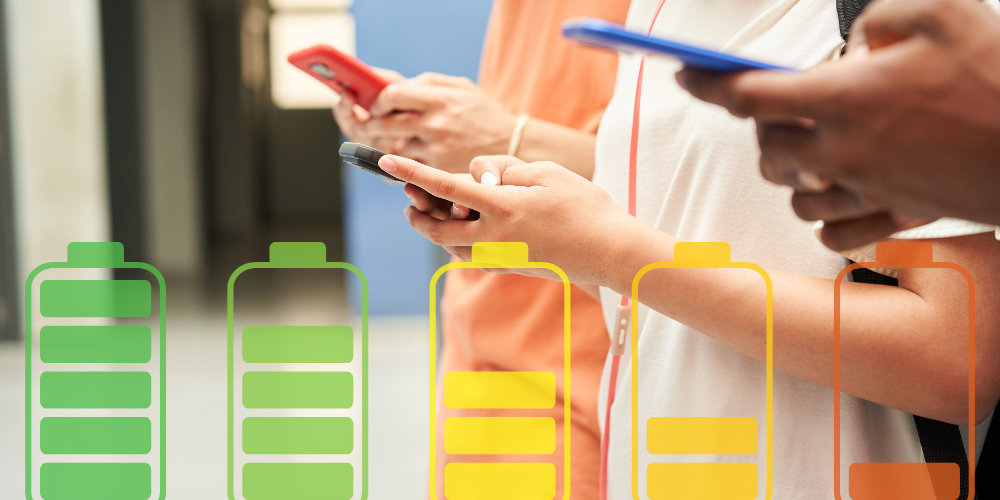
We are remarkably skilled at recognizing the needs of our devices, especially when power is running low. At 20%, we start paying attention. At 10%, brightness is lowered, low battery mode is activated, and a charger becomes a priority. At 0%, no one criticizes it for shutting down, no one tells their phone to “push through.” Humans, however, operate under different expectations. There is no visible indicator hovering above our heads to signal depletion. Even at our personal equivalent of 10%, demands rarely soften. Schedules persist. Performance requirements stay stubbornly intact.
For us, shutdown is not a feature—it’s a failure. The solution is not technological, but cultural.
The contrast becomes more unsettling when viewed alongside current research. A recent report in The New York Times describes a striking rise in anxiety, depression, and attention disorder diagnoses among children. These trends are so dramatic, they are difficult to ignore. The article notes that nearly one third of adolescents have, at some point in time, been diagnosed with anxiety. These conditions, once considered exceptional, have now become commonplace. As one researcher quoted in the article put it, the dominant response to rising student distress has not been to ask how students might adapt—but rather, how to “fix the children.” A phone in distress triggers an automatic response: reduce load, conserve energy, restore function. A child in distress triggers a different one: “fix” the child—push harder, fall behind less, disappoint no one.
This pattern continues. Findings from Harvard Medical School warn that sleep deficiency can lead to impaired memory, the inability to retain information, mood swings, and long term health problems. Sleep, in other words, is how humans recharge. Performance declines as energy disappears. Yet, culturally, depletion is normalized. A phone at 4% evokes concern. A human at 4% energy provokes encouragement to “push through.”
This logic is broken.
This is not an argument against effort or high expectations. It is an argument for knowing the difference between challenge and depletion, and for responding to the latter with care rather than demand.
We have learned to read our devices carefully. We know the signs: the dimming screen, the desperate percentage, the sudden shutdown. We have not learned to read each other the same way. Parents, teachers, schools, and students should learn to recognize exhaustion before it becomes collapse. Rest should be treated as a part of success, not evidence of failure. And we should stop wearing overwork like a badge: stop praising it, stop modeling it, stop expecting it from people who are already running on empty.
We are remarkably attentive to the needs of our devices. We should consider giving the same courtesy to ourselves.
Sincerely,
Ilana Bain, a human without a low battery mode
Related Resource: Discover more research, tools, and articles in our Well-being, Mental Health, and Stress Resource Library.
Ilana Bain, is a 9th grade student at TVT High School.
Challenge Success, a nonprofit affiliated with the Stanford Graduate School of Education, elevates student voice and implements research-based, equity-centered strategies to increase well-being, engagement, and belonging in K-12 schools.